Czech National Roundtable: From Coal Dependency to a Renewable Heat Future
The transition of Czechia's heating sector is no longer a question of if, but how. With coal expected to be phased out over the coming decade, the country faces a major opportunity to modernise its heating and cooling systems while maintaining affordability, energy security and industrial competitiveness.
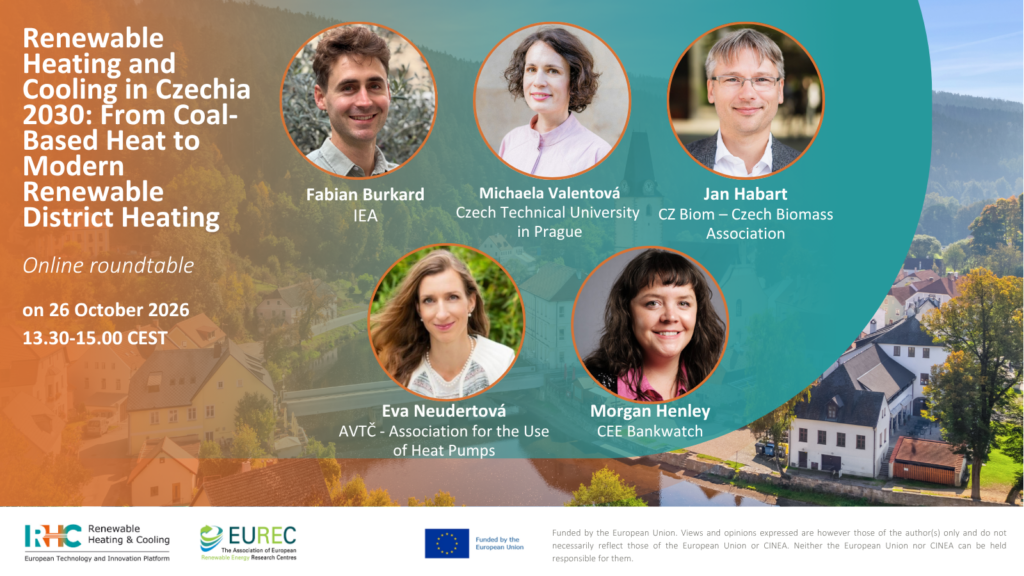
These questions were at the heart of the latest RHC-ETIP National Roundtable, which brought together experts from research, industry, civil society and international organisations to discuss pathways towards decarbonising the Czech heating sector.
A clear message emerged: Czechia already possesses many of the foundations needed for a successful transition. The challenge now lies in implementation.
Reimagining District Heating for a Post-Coal Era
District heating remains one of Czechia's greatest assets. Existing networks provide a strong foundation for decarbonisation by integrating a diverse portfolio of renewable and low-carbon heat sources, including geothermal energy, sustainable biomass, solar thermal, industrial excess heat, wastewater heat recovery, large-scale heat pumps and thermal storage.
Speakers agreed that there is no single solution suitable for every region. Instead, successful decarbonisation will depend on local planning, tailored heating and cooling strategies, and effective coordination between stakeholders.
Investment Must Follow Ambition
Transforming the heating sector will require substantial investment in infrastructure, renewable heat generation and energy efficiency improvements.
Participants highlighted the importance of funding mechanisms such as the Modernisation Fund, while also stressing the need for long-term policy stability and regulatory certainty to unlock private investment. Several ongoing projects across Czechia already demonstrate the growing potential of renewable heating solutions and provide valuable examples for future replication.
Key Takeaways
- Renewable district heating will play a central role in Czechia's energy transition, building on the country's extensive existing heat networks.
- A diversified technology mix will be needed, combining electrification, renewable gases, sustainable biomass, geothermal energy, waste heat and thermal storage.
- Biomass should be used strategically where alternatives are more difficult or costly to deploy, while biomethane offers additional decarbonisation opportunities.
- Large-scale heat pumps and waste heat recovery represent significant untapped potential, particularly in industry and district heating.
- Affordability and public acceptance will be critical. Building renovations, targeted support measures and clear communication with citizens must accompany technological deployment.
- Long-term planning certainty and stable policy frameworks are essential to mobilise investment and accelerate implementation.
As the discussion concluded, participants shared a common vision for 2030: a heating sector increasingly powered by renewable energy, supported by modern infrastructure and capable of delivering reliable and affordable heat to citizens across Czechia.
The technologies are available, the expertise exists, and the first projects are already underway. The coming years will determine how quickly Czechia can translate this momentum into a resilient and sustainable renewable heating future.
You can watch the recording of the webinar here, and access the presentations here.
